
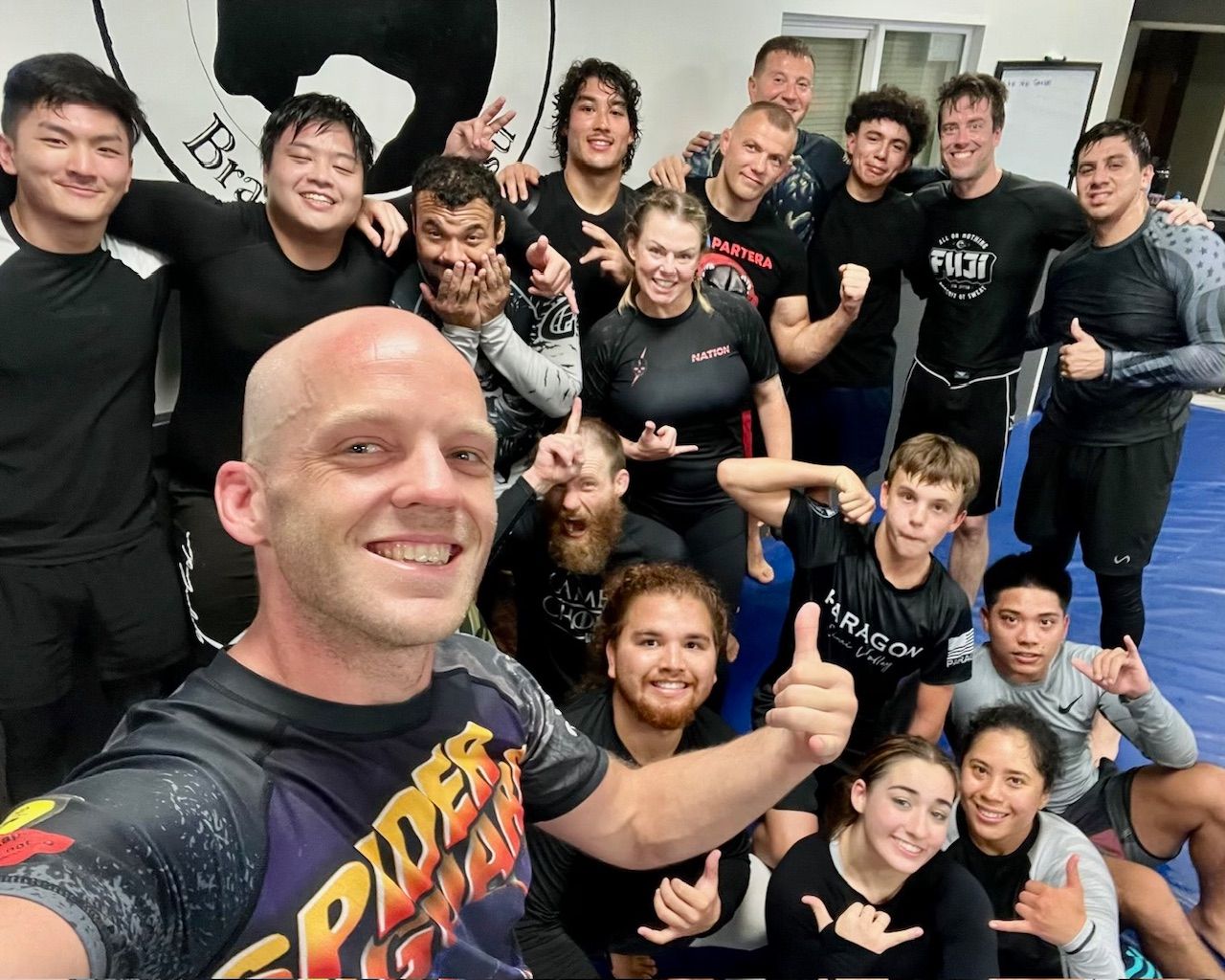
Brazilian jiu jitsu gives teens a place to practice calm decisions, respectful communication, and real confidence under pressure.
In Simi Valley, teens face a packed schedule and a constant stream of pressure, school expectations, social dynamics, tryouts, tests, and the always-on pull of screens. What a lot of families want is not another activity that just fills time, but something that builds real capability. We see brazilian jiu jitsu do exactly that because it teaches leadership the same way it teaches technique: through consistent reps, honest feedback, and learning how to stay composed in the middle of a challenge.
The interesting part is that the leadership growth is not a motivational poster kind of thing. It shows up in small, concrete moments: a teen speaking up instead of shutting down, choosing the harder right option, or staying respectful when frustrated. Research on youth brazilian jiu jitsu backs up what we watch happen on the mats, with parent reported gains in confidence, reduced anxiety, mood, mental flexibility, and life skill transfer that carry into school and home.
If you are looking for brazilian jiu jitsu in Simi Valley because you want your teen to feel safer, get stronger, and belong to a positive peer group, that is great. But if your deeper goal is leadership, responsibility, and decision making under pressure, you are in the right place for that conversation too.
Why leadership and brazilian jiu jitsu fit naturally for teens
Leadership is not just being loud, popular, or in charge. For teens, leadership often looks like taking responsibility, communicating clearly, and making good choices when emotions run high. Brazilian jiu jitsu is built around those exact behaviors because training is interactive, partner based, and structured around problem solving.
A peer reviewed article connecting BJJ to emotional intelligence and leadership highlights improvements in self awareness, emotion management, communication, and decision making in stressful conditions. That matters for teens because stress is a normal part of adolescence, and many teens do not get regular practice at staying calm while still taking action.
BJJ also gives teens something rare: immediate feedback. When a technique works, you know. When it does not, you adjust. That loop builds the kind of humility and resilience that strong leaders rely on, especially in school, sports, and first jobs.
The leadership loop we teach every week
In class, we are not just teaching moves. We are building habits that show up outside the gym. A typical leadership loop looks like this:
• Learn a skill with clear expectations and a specific goal
• Practice it with a partner while communicating and staying safe
• Test it with controlled resistance and accept the result honestly
• Reflect, adjust, and try again instead of making excuses
• Encourage your partner and take responsibility for your own effort
That cycle sounds simple, but it is exactly what teens need to become dependable, calm leaders.
Confidence that is earned, not performed
A big reason families search for BJJ in Simi Valley is confidence. The good news is that confidence in brazilian jiu jitsu is earned through progress you can feel, not hype. In a 2024 survey of children in BJJ, parents reported confidence improvements in 96.4 percent of participants and reduced anxiety in 87.5 percent. Those numbers line up with what we see: when teens learn how to solve problems with their body and mind working together, they carry themselves differently.
We also like that this confidence tends to come with humility. Teens learn quickly that progress is real, but it is never finished. That is a healthy mindset for leadership because it keeps a teen open to coaching, feedback, and learning.
For shy teens, this matters even more. A teen does not have to be outgoing to become a leader. Leadership can look like being consistent, being respectful, and being the person others trust in a stressful moment. BJJ gives quieter teens a way to develop presence without forcing a personality change.
Emotional intelligence: staying calm is a skill, not a personality trait
Emotional intelligence is one of the strongest predictors of healthy leadership. Teens do not magically become emotionally regulated under pressure. It takes training. Brazilian jiu jitsu creates safe, supervised pressure where teens can practice:
• Not panicking when something feels difficult
• Breathing, thinking, and choosing a response
• Resetting after a mistake
• Treating partners with respect even when competitive energy shows up
Research specifically links BJJ practice to improved self awareness, emotion management, communication, and decision making under uncertainty. That is leadership language. And it is also everyday teen life language, because school and friendships often feel uncertain and high stakes.
We also see emotional intelligence grow through the tap out culture. Teens learn that tapping is not losing. It is communication. It is self awareness. It is the ability to say, I am at my limit, and that is actually a mature, leadership level choice.
Decision making under pressure: every roll is a leadership drill
If you want a simple way to understand why brazilian jiu jitsu builds leaders, look at sparring, or rolling. Rolling is not chaotic fighting. It is controlled problem solving with rules, coaching, and safety standards. Teens make dozens of small decisions in a short round:
Should I escape or defend and wait?
Do I keep pushing or reset my position?
Do I try something new or go back to fundamentals?
How do I stay calm when I get stuck?
That rapid decision making is one reason BJJ transfers so well to real life. A 2025 study on lifelong skills learned through BJJ reported that over 96 percent of youth participants experienced transfer of life skills into other areas, with parents noting benefits like emotional regulation, social bonds, and respect. When a teen practices calm choices repeatedly in training, that habit shows up during tests, presentations, conflicts, and stressful social moments.
Respect, communication, and the kind of teamwork that lasts
Leadership without respect is not leadership. It is just control. In our teen classes, respect is not a slogan. It is built into how we train.
Your teen has to communicate with training partners, ask questions, and listen to coaching. Partners have to cooperate for drilling to work. Teens learn quickly that being careless or ego driven makes training worse for everyone. That realization is powerful because it is not theoretical. It is immediate.
Parent reported outcomes in youth BJJ research include improved respectfulness and strong social benefits. And in real class life, that looks like teens learning to be steady training partners, to help someone who is new, and to accept correction without taking it personally. Those are leadership behaviors that translate directly to group projects and team sports.
What leadership looks like on the mat
We like to describe leadership in simple, visible actions. In a typical month, we watch teens practice leadership when they:
• Show up prepared, on time, and ready to train
• Ask a clear question instead of pretending to understand
• Encourage a partner who is struggling with a technique
• Control intensity so everyone stays safe
• Take a loss in sparring, learn from it, and come back focused
None of that requires a teen to be the loudest person in the room. It requires maturity, and maturity is trainable.
Belt progression and personal responsibility
One reason teens respond well to brazilian jiu jitsu is that progress is tied to effort, consistency, and skill development. Promotions are earned, not negotiated. That creates a clean connection between action and outcome, which is exactly what we want teens to internalize.
This matters for leadership because responsibility grows through repetition. Teens begin to manage their own gear, track what they are working on, and set goals. That is leadership practice in the most practical sense: planning, following through, and improving step by step.
When teens hit a plateau, which happens to everyone, we help them learn a healthy response: identify a specific weakness, focus on it, and stay consistent. That same approach works for school, music, jobs, and sports.
Safety and structure: what parents in Simi Valley want to know
Safety is usually the first question we hear, and it is a fair one. Brazilian jiu jitsu is a grappling based martial art with controlled training, clear rules, and a strong safety culture. We emphasize tapping early, partner awareness, progressive intensity, and supervision so teens learn in a structured way.
Parents also appreciate that BJJ teaches self defense without teaching aggression. The goal is calm capability, not picking fights. In fact, as teens become more competent, we often see less impulsiveness, because confidence reduces the need to prove anything.
If your teen is new, we build skills in layers. We start with fundamentals, movement, and positional awareness before adding more resistance. That helps teens feel successful early while still being challenged.
How often teens should train to see leadership benefits
Families are busy, and we respect that. Research samples in youth BJJ often include kids training multiple times per week, and broader martial arts data suggest that training at least twice per week is linked to better stress coping outcomes. In practical terms, we usually recommend starting with 2 to 3 sessions per week so your teen builds momentum without burning out.
Consistency matters more than intensity. Leadership growth comes from showing up, trying, making mistakes, and returning with a better plan. If your teen trains once every couple of weeks, it is hard to build that rhythm. If your teen trains regularly, you tend to see changes that stick.
From the mat to school and life in Simi Valley
Leadership skills only matter if they transfer. That transfer is one of the strongest themes in youth brazilian jiu jitsu research, with over 96 percent of parents reporting life skills carrying into other parts of life. In a Simi Valley context, that often shows up in a few familiar places:
School and academics
Teens learn to break big goals into steps, manage frustration, and stay coachable. That helps with studying, group projects, and asking for help when needed.
Social pressure and bullying
BJJ builds calm confidence and posture. Teens who feel capable tend to de escalate more naturally, and they are less likely to get pulled into status games.
Sports and performance
Decision making under pressure, breathing control, and resilience after setbacks translate to tryouts, competition nerves, and team dynamics.
First jobs and responsibilities
Showing up on time, communicating clearly, and taking feedback without spiraling are real workplace leadership skills. Our teens practice those behaviors every week.
Why brazilian jiu jitsu is growing so fast right now
Brazilian jiu jitsu has grown dramatically in visibility and participation over the last two decades. Search interest across the U.S. has risen by over 100 percent from 2004 to 2024, and youth participation has followed that trend. Families are drawn to BJJ because it balances fitness, discipline, and community, and because it rewards strategy and consistency more than size or aggression.
Motivation research on BJJ practitioners points to drivers like competence, social connection, enjoyment, fitness, and appearance. For teens, competence and social connection are huge. They want to feel capable at something real, and they want to belong. A well run teen program delivers both, and that is one reason teens stick with it long enough to gain deeper leadership skills.
Take the Next Step
If your goal is to help your teen become more confident, calm, and capable, brazilian jiu jitsu is one of the most practical paths we know, and the leadership benefits are not accidental. We build leadership into the way we coach, the way we structure training, and the expectations we hold on the mat, because those habits are what transfer into school, friendships, and early adulthood.
At Paragon Simi Valley, we focus on giving Simi Valley families a place where teens can learn real self defense while also developing emotional intelligence, responsibility, and decision making under pressure, the kind of leadership that holds up when life gets a little messy.
Take what you learned here and apply it through hands-on Brazilian Jiu-Jitsu training by joining a free trial class at Paragon Simi Valley.