
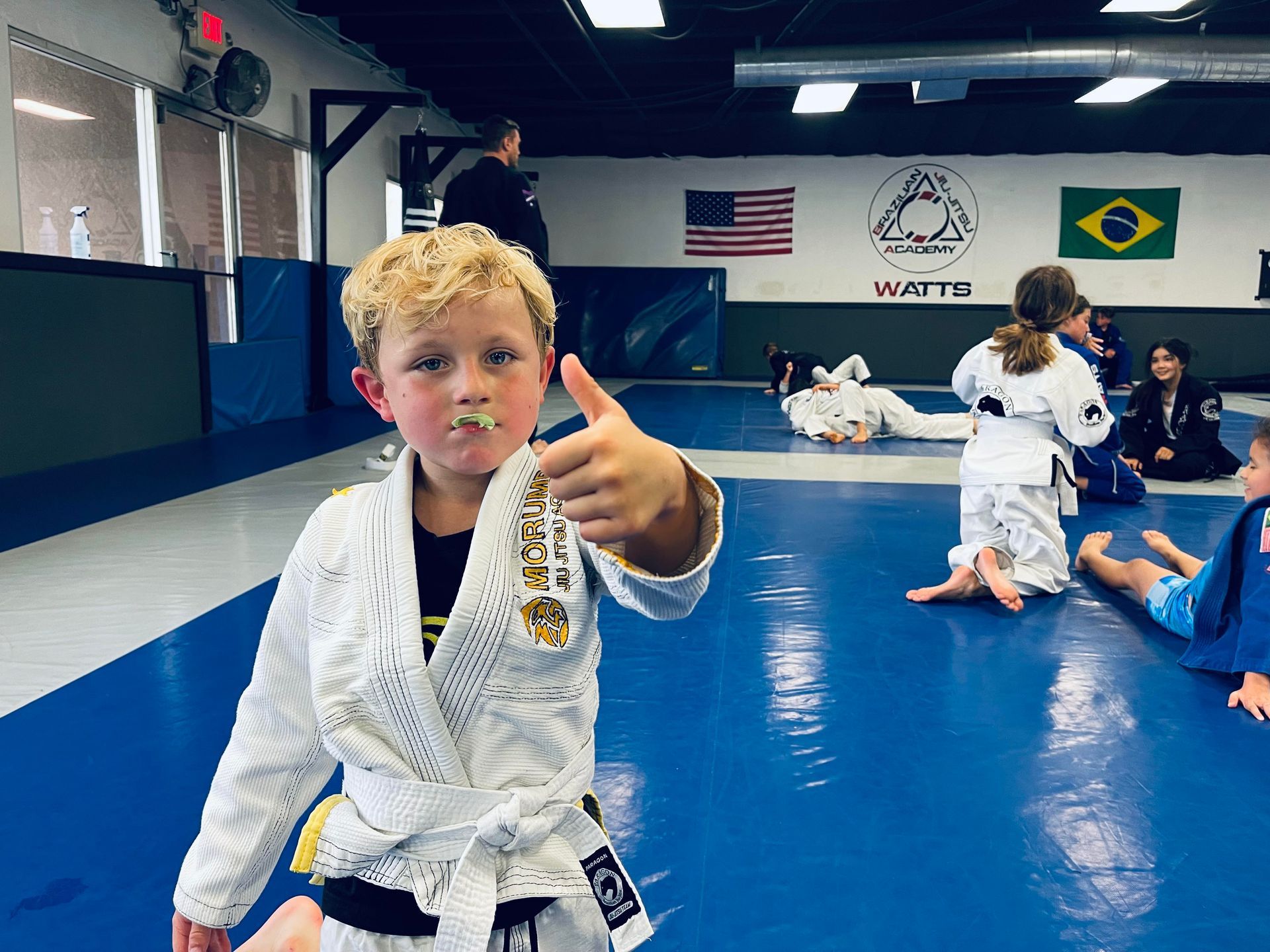
Brazilian jiu jitsu turns everyday stress into a skill you can train, measure, and steadily outgrow.
In Simi Valley, life moves fast in a quiet sort of way: work, school pickups, commuting, errands, and the constant feeling that your mind is still open in too many tabs. We see people walk in looking for a workout or self-defense, but what keeps you coming back is often personal growth you can actually feel week to week. That is one reason brazilian jiu jitsu has become such a powerful anchor for so many locals.
We teach brazilian jiu jitsu as a practical, coach-led process: learn a position, practice the details, pressure-test it safely, then reflect and improve. That rhythm does something interesting to your mindset. You build the habit of staying calm while solving problems, even when the problem is literally trying to pin you to the mat.
Recent sport psychology research lines up with what we experience on the mats. Studies in the last couple of years have linked consistent BJJ training with higher confidence, resilience, mood, and life satisfaction, plus lower anxiety for many practitioners. The science is encouraging, but the real value is how it shows up in your daily life in Simi Valley: steadier nerves at work, more patience at home, and a stronger sense of who you are when things get uncomfortable.
The science behind personal growth through brazilian jiu jitsu
When people call BJJ “therapy on the mats,” we understand what they mean, even if it sounds a little dramatic at first. BJJ puts you in controlled, challenging situations where you have to breathe, think, and act with intention. You cannot bluff your way through it. You also cannot “win” your way out of being a beginner. That combination builds real confidence instead of the fragile kind.
A 2024 peer-reviewed study looking at over 400 BJJ practitioners found that higher belts reported significantly more mental strength, resilience, self-efficacy, self-control, and life satisfaction, along with fewer mental health disorders compared to beginners. Training experience also correlated positively with grit, perseverance, and self-control. In plain language: sticking with BJJ tends to strengthen the exact mental skills most of us want more of.
Another study on lifelong skills learned through BJJ reported results that are hard to ignore: most adult participants said BJJ improved confidence, reduced anxiety, and improved mood, and everyone reported a strong sense of community and respect. That community piece matters more than people expect, especially for adults who feel isolated after work, parenting, or long commutes.
We do not treat research like marketing. We use it as a compass. It helps explain why certain training habits work: showing up consistently, learning to regulate emotions under pressure, and getting support from training partners who want you to improve, not fail.
Why this matters for Simi Valley locals specifically
Simi Valley is full of people juggling responsibilities. Many of you are balancing work demands with family time, or trying to stay active without spending hours planning workouts. BJJ can be surprisingly time-efficient because it trains multiple systems at once: strength, mobility, conditioning, coordination, and decision-making.
There is also something about suburban life that can be sneaky. You can have a stable routine and still feel disconnected. A healthy “third place” outside home and work makes a difference, and a consistent academy culture can become that place. You learn names, you learn habits, and you start recognizing the quiet wins: better posture, better boundaries, better sleep, a calmer response to stress.
Safety and self-defense confidence are real concerns in Southern California as well, and BJJ offers a practical path without relying on striking. You learn how to control distance, manage clinches, escape pins, and create space. That kind of competence has an emotional effect: you stand a little taller, and you make decisions with less fear.
How personal growth actually happens on the mat
We like to think of growth in BJJ as three layers that build on each other: skill, stress tolerance, and identity.
Skill gives you options. Options reduce panic. Reduced panic gives you clarity. And clarity is where growth lives.
In class, you learn positions and concepts like posture, frames, balance, leverage, and timing. Those are technical ideas, but they also teach a mindset: do the small things correctly, even when you are tired. That principle transfers cleanly to work, school, and relationships.
Then there is controlled stress. Rolling, when done responsibly, is a pressure test. Someone is trying to improve position. You are trying to stay safe and solve the problem. Your body reacts, but you learn to breathe through it. Over time, your nervous system gets better at “not spiraling.” For many people, that is the hidden superpower of BJJ.
Finally, identity changes. You become someone who shows up. Someone who can struggle without quitting. Someone who can ask questions, accept correction, and keep going. That identity shift is what turns “a hobby” into personal growth you carry everywhere.
Confidence that is earned, not borrowed
Confidence in brazilian jiu jitsu is not about being loud. It is earned through reps. You learn a guard pass, get stuck, make a tiny adjustment, and suddenly it works. It is a small victory, but it is yours.
One study on life skills in BJJ reported that 87.6 percent of adult participants said BJJ improved their confidence. We see why. You are constantly proving to yourself that improvement is possible, even if you start out awkward, stiff, or unsure.
You also learn that confidence can coexist with humility. You will tap. You will get caught. That is normal. And oddly enough, tapping can be empowering when you understand it: you are practicing safety, awareness, and self-control. You are choosing learning over ego.
In daily life, that looks like speaking up at work without over-explaining, setting clearer boundaries, or staying present in a hard conversation instead of shutting down. Those are real wins, and they tend to arrive quietly.
Resilience and the skill of staying calm under pressure
Resilience is not a motivational poster. It is a trained response.
BJJ offers repeated exposure to discomfort in a safe environment. You learn to problem-solve while tired, while pinned, while frustrated, while your first plan fails. That repetition teaches perseverance. It also teaches adaptability: if one escape does not work, you do not freeze, you move to the next option.
A scoping review focused on veterans and first responders found BJJ can support psychological resilience, cognitive function, and focus, in part because of the constant strategy and decision-making under pressure. You do not need to be in a high-stress career to benefit from that. But if you are, you will recognize the value quickly.
In Simi Valley, resilience often means handling normal life better: traffic, deadlines, parenting moments, social pressure, and the low-grade anxiety that comes from always being “on.” Training gives you a place to put that energy, and a way to practice responding instead of reacting.
Mental health benefits: mood, anxiety, and the reset effect
We are careful with mental health language because everyone’s situation is different. But it is fair to say that many people report BJJ helps them feel better day to day. In the lifelong skills research, 87.5 percent of adults reported reduced anxiety and 96.9 percent reported improved mood.
There are practical reasons for this. Training is physical, which helps regulate stress. It is also focused. When you are drilling a technique, you cannot multitask or doomscroll. Your attention gets pulled into the present moment, and that can feel like a reset.
Then there is the social layer. The same study reported a strong sense of community and respect for all participants. Feeling known, even in a simple way, can be stabilizing. You show up, your teammates notice, and you share progress in a way that does not require small talk or a perfect personality.
Life skill transfer: what you learn in BJJ shows up at work and home
One of the most interesting research findings is how often skills transfer off the mat. In that BJJ life skills study, 96.9 percent of participants reported using BJJ-developed skills in other areas of life.
We see this constantly, especially with adults who thought they were “just” signing up for fitness. You start organizing your week around training, and suddenly you are better at planning in general. You start working a technique systematically, and you become more patient with learning curves at work. You learn to accept feedback without taking it personally, and your relationships improve.
Here are a few of the most common life skills we see you build through training:
• Discipline that feels practical because it is tied to a real schedule and real progress
• Patience because rushing usually makes techniques fail, and you learn that quickly
• Problem-solving because every roll is a new puzzle with real-time consequences
• Emotional regulation because frustration is normal, but you learn to steer it
• Respect and accountability because partners trust you to train safely and responsibly
These are not abstract character traits. They are behaviors you practice multiple times per week.
Kids and teens: growth without feeding aggression
For parents, one big question is whether martial arts will make a child more aggressive. Research on youth BJJ suggests the opposite when training is structured well: improvements in self-control, social skills, and pro-social behavior, without an increase in aggression.
Our kids and teen classes are built to channel energy into skill and discipline. Students learn clear rules, safe movement, and how to be a good partner. They also learn what “calm” feels like in their body. That matters for school, sports, and friendships.
For teens especially, BJJ can be a healthy identity builder. It is individual progress in a team environment. You cannot hide, but you are not alone either. Over time, students tend to carry themselves differently: more grounded, less reactive, more confident without needing to prove anything.
What to expect in your first class
Beginners often worry about being “in the way” or not knowing what to do. We handle that. Your first class is structured, and we coach you through each piece so you can focus on learning, not guessing.
A typical first experience includes a warm-up that prepares your joints and breathing, a technical lesson that introduces foundational positions, and partner drills where you practice at a manageable pace. If there is sparring, it is introduced carefully and with clear expectations. Safety and communication come first.
If you are looking for brazilian jiu jitsu in Simi Valley but feel nervous about starting, that is normal. Most people feel it. It usually fades quickly once you realize everyone started exactly where you are.
How often should you train to feel the change
Consistency beats intensity, especially at the start. For most people, training two to three times per week creates momentum without burning you out. That rhythm is also consistent with how many practitioners report noticeable shifts in mood, confidence, and stress over the first few months.
We also encourage you to think in seasons. Some weeks will be busy. Some months you will train more. The key is staying connected to the process, not chasing perfection.
If your goal is personal growth, treat training like practice for life: show up, do what you can, learn something small, and stack those small improvements. That is how BJJ in Simi Valley becomes part of who you are, not just something you try once.
Common questions we hear from new students
Am I too old or out of shape to start?
No. We coach all fitness levels. You start with fundamentals, build mobility and conditioning gradually, and learn how to train smart. BJJ scales well because technique matters more than raw athleticism.
Is it safe?
BJJ is a contact sport, so there is always some risk, but culture and coaching make a big difference. We emphasize tapping early, controlling intensity, and pairing training partners responsibly.
How long until I feel different?
Many students notice changes in stress, mood, and confidence within a few months of consistent training. Physical changes often show up alongside it: better endurance, better posture, and better body awareness.
Will this make me more aggressive?
Good training tends to increase self-control, not aggression. You learn restraint, respect, and how to stay composed under pressure.
Ready to Grow with Paragon Simi Valley
Building yourself up is not always about adding more tasks to your week. Sometimes it is about choosing one practice that improves everything else. Brazilian jiu jitsu does that by teaching you how to breathe under pressure, solve problems calmly, and keep showing up when progress is slow.
If you want to experience BJJ in Simi Valley in a way that is structured, supportive, and focused on long-term growth, we would like to help you start strong at Paragon Simi Valley. We keep the process clear, the culture respectful, and the training practical so your progress does not feel like a mystery.
Develop real grappling skills through structured training by joining a free Brazilian Jiu-Jitsu trial class at Paragon Simi Valley.