
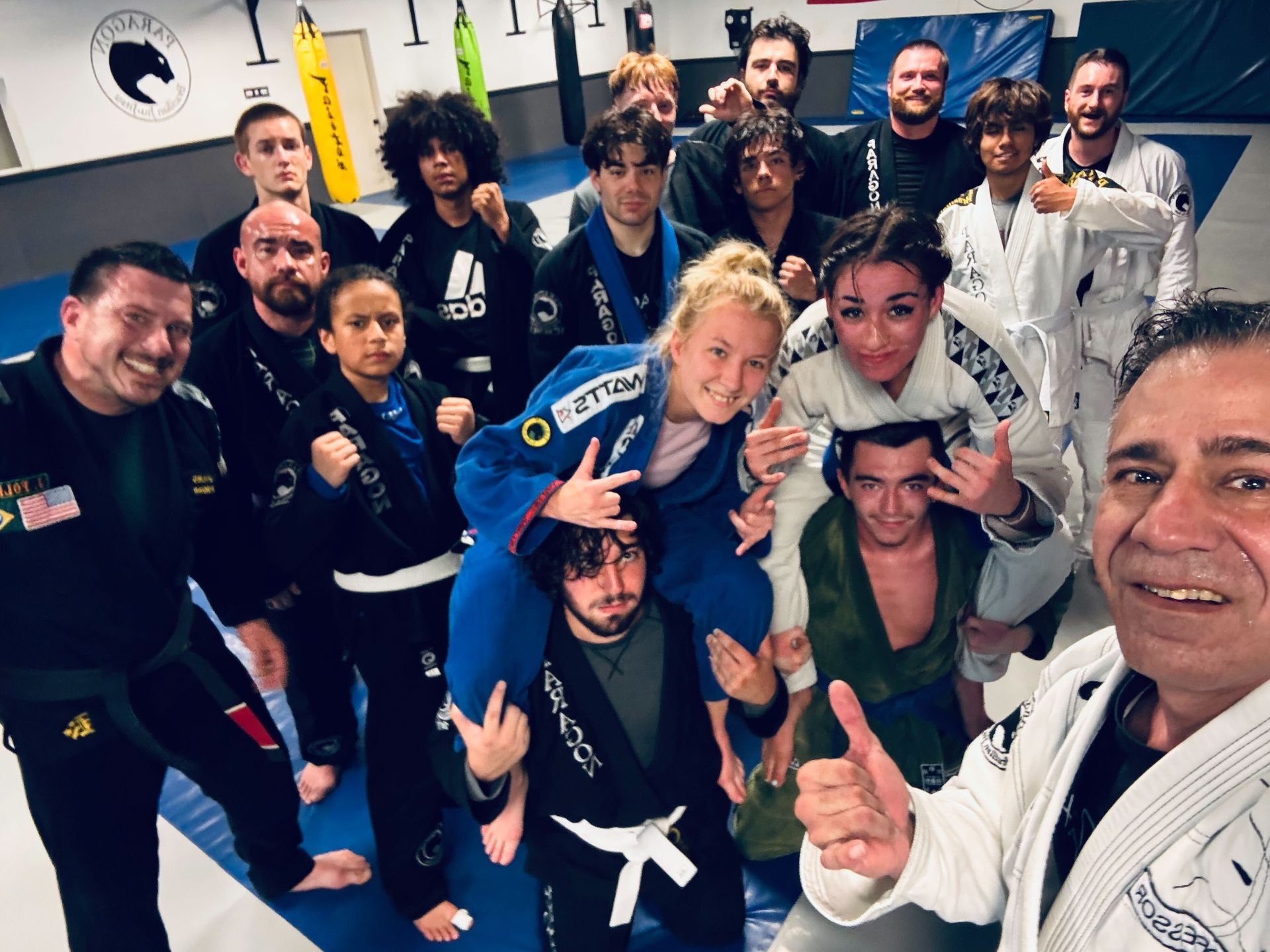
One good class can feel like hitting a reset button: your body works hard, your mind gets quiet, and you walk out lighter.
Stress has a way of stacking up in Simi Valley. Long workdays, commuting into greater LA, family schedules, screens everywhere, and the constant feeling that you should be doing one more thing. We meet a lot of adults who are not looking for a new hobby as much as they are looking for a reliable way to decompress and feel like themselves again.
That is where brazilian jiu jitsu fits in. It is a demanding martial art, yes, but it is also surprisingly grounding. When you train, your brain cannot multitask. You cannot worry about your inbox while someone is trying to pass your guard. You have to breathe, pay attention, and respond in real time. That present-moment focus is the same muscle mindfulness builds, just trained in a very physical, very practical way.
In this guide, we will explain how brazilian jiu jitsu supports stress management and mindfulness, what the experience feels like in a real class, and how you can start training in a way that matches your schedule, your fitness level, and your goals.
Why stress sticks, and why movement alone is not always enough
Most people already know exercise helps with stress. You get endorphins, your sleep improves, and your body finally uses some of that restless energy. But many stressed adults still struggle to turn their brains off. You can run five miles and spend the whole time thinking about work.
One reason brazilian jiu jitsu is different is that it requires full attention. It is often called physical chess for a reason. You are constantly reading balance, pressure, angles, timing, and small shifts in posture. Your mind is busy, but in a clean way, focused on one clear problem at a time. For many students, that focus is the break they have been missing.
There is also a growing research base supporting what practitioners have reported for years. Recent studies and reviews suggest consistent BJJ training is associated with lower stress, better mood, and higher mindfulness, along with improvements in resilience, self-control, and overall mental health. A 2024 study of hundreds of practitioners also linked greater training experience and rank with higher mental strength, resilience, life satisfaction, and fewer reported mental health disorders. We do not treat training as a replacement for professional care when you need it, but we do take seriously that the mats can be a powerful complement to a healthy plan.
How brazilian jiu jitsu trains the nervous system to stay calm under pressure
Stress is not only a feeling. It is a nervous system state. When you are overwhelmed, your body shifts toward fight-or-flight: shallow breathing, tension in your shoulders and jaw, fast thoughts, narrow attention. The interesting thing about BJJ is that it safely recreates pressure in a controlled environment, then teaches you how to function inside it.
You learn to breathe when it would be easier to panic
A classic example is getting pinned under side control or mount. The first-time experience can feel intense because your body reads the weight and closeness as a threat. In class, we coach you to slow down, exhale, and find small improvements rather than trying to explode out. That is not just technique. That is emotional regulation in a very real form.
Over time, you learn a practical lesson your nervous system remembers: pressure is not the same as danger, and discomfort is not the same as failure. That shift alone can reduce day-to-day anxiety because you stop treating every hard moment like an emergency.
You practice decision-making while your heart rate is up
Mindfulness is not only about being calm on a cushion. For most adults, the real test is staying present in motion: during conflict, deadlines, parenting stress, or a difficult conversation. In BJJ, you build the habit of noticing what is happening, choosing a response, and committing to it, even when you are tired.
This matters because stress often pulls you into spirals: what-ifs, worst-case scenarios, and self-criticism. Training interrupts that loop. Your attention returns to what is real and immediate: grips, frames, posture, base, and breathing.
Mindfulness on the mat: why BJJ feels like meditation for people who hate sitting still
Some people love traditional mindfulness practice. Many others find sitting meditation frustrating. We get it. If your mind is already loud, sitting in silence can feel like giving it a microphone.
Brazilian jiu jitsu creates mindfulness through immersion. Rolling is not a place where you can drift. If you drift, you get swept, submitted, or stuck. So you stay here, in the present, because the moment requires it.
You will also notice that BJJ gives you feedback that is immediate and honest. If you tense up, you gas out faster. If you hold your breath, you panic sooner. If you rush, you make openings. When you relax and work step by step, you last longer and see more options. That is mindfulness with consequences, and it tends to stick.
The mental health benefits research is starting to measure
We like to keep claims grounded. Not every person will experience the same results, and training is still training: you will have hard days and frustrating rounds. But the overall pattern is encouraging.
Here are some findings that match what we see in long-term students:
• More experience in BJJ is associated with higher resilience, self-efficacy, self-control, and life satisfaction, and fewer reported mental health disorders in a large 2024 study of practitioners.
• Reviews focusing on veterans and first responders have reported substantial reductions in PTSD symptoms, depression, and anxiety among participants, with benefits that can persist over time.
• Other research has noted improvements in emotional symptoms and behavior in children, along with increased self-control.
The takeaway is simple: consistent training does not only change your body. It changes how you respond to stressors, and that can ripple into work, home, and relationships.
Why BJJ in Simi Valley works especially well for busy adults and families
Simi Valley life often runs on tight margins. People squeeze workouts between traffic, school pickup, dinner, and everything else. A big reason students stick with BJJ is that it gives a lot back in a relatively compact time.
A single class can deliver three things that stress management usually requires:
• Physical exertion that helps regulate sleep and mood
• Full mental engagement that blocks rumination for an hour
• Real social connection with people who are also working on themselves
That combination is why many people searching for BJJ in Simi Valley are not only looking to learn self-defense. They want a healthier way to process stress that does not involve zoning out, scrolling, or just powering through.
What a stress-relief focused class actually looks like
People sometimes picture martial arts as either chaotic fighting or intense competition. Our day-to-day training is more structured and more beginner-friendly than most newcomers expect.
A typical class includes a warm-up that prepares your joints and breathing, technique instruction with clear details, drilling with a partner, and controlled sparring (rolling) where you apply skills at an appropriate intensity. You will always have the option to go lighter. Tapping is normal and respected. Communication is part of safety.
If your main goal is stress relief, we also coach you differently in small ways. We cue you to notice when you are holding your breath. We remind you that you can slow down. We emphasize problem-solving over forcing. It is a training environment where you can work hard without getting swallowed by adrenaline.
Concrete tools you can use right away for mindfulness and stress
You do not need to wait months to feel benefits. Many students notice improved mood and sleep within the first few weeks, especially when training becomes a routine. Here are a few practical tools we encourage, because they work on and off the mats.
A simple pre-class mental switch
Before you step on the mat, take 30 seconds in your car or at the edge of the room:
1. Inhale through your nose for a count of four.
2. Exhale slowly for a count of six.
3. Relax your shoulders and unclench your jaw.
4. Choose one intention for class: breathe, stay curious, or move smoothly.
It is a small ritual, but it tells your body that the workday is over and training time is starting.
A pressure-breathing habit during rolling
When you get stuck under pressure, your goal is not to win the moment. Your goal is to stay calm enough to see the exit. Try this:
• Exhale first, long and steady
• Make one frame, not five
• Move one inch at a time
• Reset your breathing before your next effort
That is mindfulness in motion. And it is surprisingly transferable to real-life stress.
Beginner anxiety: what if you feel intimidated or out of shape?
This is one of the most common barriers for adults searching for brazilian jiu jitsu in Simi Valley. You may worry that everyone will be more athletic, more coordinated, or more intense.
We build training progressively. You do not need to arrive in shape. You get in better shape by showing up. You also do not have to spar hard right away. Many beginners start with fundamentals, learn how to move safely, and gradually add rounds as confidence grows.
We also match partners intentionally. A good first month is not about proving toughness. It is about building comfort, learning basic positions, and starting to understand how to breathe under pressure without freaking out. That is a real skill, and it develops faster than you might expect.
Kids and teens: focus, emotional regulation, and confidence without aggression
Parents often ask if martial arts will make a child more aggressive. With the right coaching culture, the opposite tends to happen. Research on youth BJJ has linked training to improvements in self-control and reductions in certain behavioral and emotional problems. In plain terms, kids learn to pause, listen, and follow structured steps.
BJJ gives kids and teens something rare: a place where effort is celebrated, mistakes are normal, and progress is measurable. That matters for stress too. School pressure can be intense, and many teens carry anxiety that looks like irritability or withdrawal. Training gives them a constructive outlet and a sense of competence that is earned, not given.
For families, it also helps that training can be a shared rhythm. Many parents like pairing kids’ classes with their own sessions. It turns training into a household habit, not another scattered commitment.
How often you should train to notice stress and mindfulness benefits
Consistency matters more than intensity. For most adults, we recommend starting with two to three classes per week. That is enough frequency to build skill, create routine, and feel noticeable changes in mood, patience, and focus.
If your schedule is tight, even two classes per week can be meaningful. The key is making it a non-negotiable appointment with yourself. Stress thrives in chaos. Training adds structure.
Ready to Begin
If you want a practical way to manage stress, build mindfulness, and feel more capable in your own skin, brazilian jiu jitsu gives you a path you can actually follow. The mats provide a place to work hard, breathe, focus, and leave the mental noise behind for a while, and that adds up over months in a way that surprises people.
We built our programs at Paragon Simi Valley to support real life in Simi Valley: busy schedules, beginner nerves, and long-term goals that go beyond fitness. When you are ready, we will help you start at a pace you can sustain and keep it enjoyable enough to stick with.
Become part of a team that values growth and respect by joining a free Brazilian Jiu-Jitsu trial class at Paragon Simi Valley.