
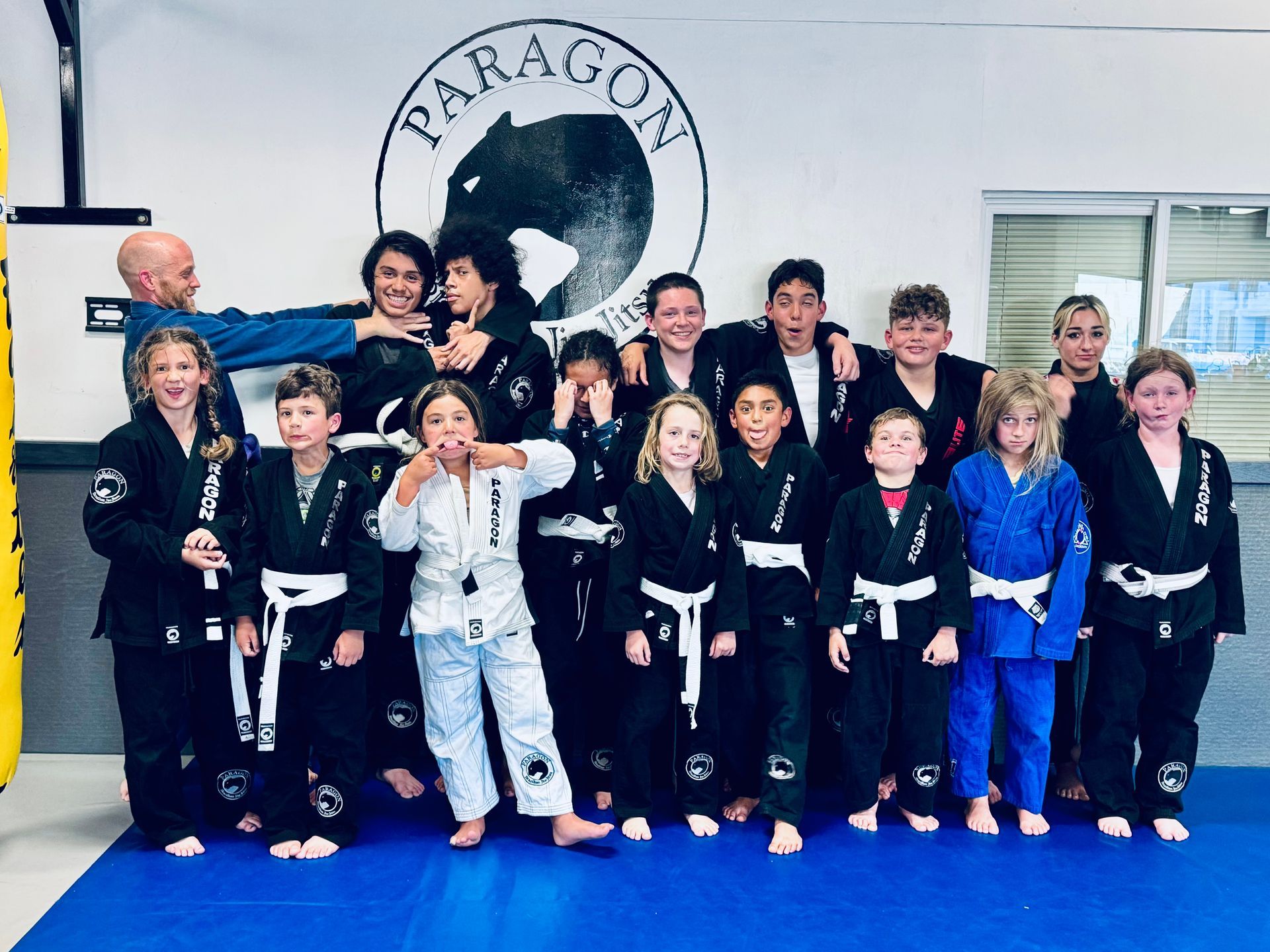
Youth Brazilian Jiu-Jitsu gives kids a place to move, think, and grow in ways you can actually see week to week.
If you are looking for an after school activity that does more than “burn energy,” Youth Brazilian Jiu-Jitsu checks a lot of boxes in a surprisingly practical way. We get questions from Simi Valley parents about safety, confidence, bullying, focus, and how to find something structured that still feels fun for a kid. Those concerns are real, and we built our youth program to address them head on.
What makes BJJ different for kids is that progress is visible. Your child learns how to move their body with control, how to stay calm when something feels challenging, and how to solve problems under a little pressure. Not pressure that overwhelms them, but the kind that teaches them to breathe, listen, and try again.
Youth martial arts participation has climbed in recent years, with the National Federation of State High School Associations noting an increase of over 13,000 participants from 2018 to 2021-2022. That lines up with what we see locally: families want an activity that supports fitness and character at the same time, and Youth Brazilian Jiu-Jitsu does that in a way that keeps kids engaged.
Why Youth Brazilian Jiu-Jitsu fits Simi Valley family life
Simi Valley is full of families balancing school, homework, sports, and work schedules. When time is tight, you want an activity that pays off in multiple areas: physical health, confidence, and behavior at home and school. Youth Brazilian Jiu-Jitsu is efficient like that because every class blends movement, skill building, and social learning.
We also keep our coaching age appropriate. Kids are not just small adults, so we do not teach them like adults. We use clear rules, predictable class structure, and simple coaching cues that match how kids learn. Over time, that structure becomes a comfort. Many students walk in a little unsure at first, then start to settle in because class feels consistent and safe.
Just as important, BJJ in Simi Valley has become a strong community activity. The youth ecosystem is active, with major platforms tracking huge numbers of matches and tournaments nationwide. Competition is optional, but the growth matters because it means the sport has a clear path for long term development. Your child can stay with it for years without “aging out” of interest.
The research backed benefits parents care about most
Parents usually come in asking about self defense, but the benefits that keep families training are broader. Reviews of youth martial arts research consistently show improvements in strength, flexibility, cardiovascular health, balance, coordination, self esteem, emotional regulation, and reduced aggression. That is a big list, but it matches what many parents notice: kids move better, manage frustration better, and carry themselves differently.
UNESCO linked guidance also highlights that martial arts can help children meet daily physical activity recommendations through moderate to vigorous movement. In plain terms, our classes get kids moving. They sweat, they learn, and they do not have to be “the athletic kid” to benefit.
Here is how those benefits often show up in day to day life:
• Better body awareness: kids learn how to fall safely, base out, and control their balance
• More patience: techniques take repetition, and repetition teaches steady effort
• Calm under pressure: positional sparring teaches kids to breathe and think before reacting
• Confidence without arrogance: students learn competence, and competence changes posture and tone
• Social growth: training partners matter, so kids practice respect, cooperation, and communication
When people talk about character development, this is what it looks like on the mat. Small wins, repeated often, until they become habits.
Safety first: what “safe” youth BJJ actually means
It is fair to ask: is Brazilian Jiu-Jitsu safe for kids? Our answer is that safety is not an assumption, it is a system. Youth Brazilian Jiu-Jitsu is primarily grappling, and our focus is control. We teach students to use leverage and positioning rather than striking, and we keep sparring structured and closely coached.
We manage safety in a few practical ways. First, we teach tapping early and we reinforce it constantly. Kids learn that tapping is not losing, it is communicating. Second, we match partners thoughtfully and keep intensity appropriate for age and experience. Third, we build skills in layers. A child does not need to “be tough” to do well. We want them to be aware, controlled, and coachable.
If you are worried about injuries, you are not alone. That is why we emphasize fundamentals, warm ups that prepare joints and muscles, and a culture of taking care of training partners. The goal is long term training, not short term intensity.
Confidence, bullying, and real world boundaries
One of the strongest reasons families choose Youth Brazilian Jiu-Jitsu in Simi Valley is confidence that is earned, not forced. Kids learn what it feels like to be grabbed or pinned in a controlled setting, then they learn how to escape with technique. That experience changes how a child interprets everyday conflicts. Situations feel less scary when you have practiced staying calm.
Pediatric focused guidance often notes that youth martial arts can improve mindfulness, self control, stress reduction, and bullying resistance. The “bullying” piece matters, but we handle it responsibly. We do not teach kids to fight at school. We teach awareness, boundaries, and de escalation first, and we reinforce that physical techniques are a last resort when safety is at stake.
In our coaching, we also talk about posture, voice, and decision making. Bullies often look for easy targets. When a child stands taller, makes eye contact, and has a steadier tone, that alone can change social dynamics. It is not magic, but it is real.
Why kids stay engaged: the built in progression
Some activities lose steam after a season. Youth Brazilian Jiu-Jitsu tends to keep kids interested because there is always another skill to learn, and progress is personal. Even if two kids start on the same day, their journeys look different. One child may love movement and athletic positions, another may be more technical and methodical. Both can succeed.
We use clear progress markers and a structured curriculum that helps kids understand what comes next. That structure lowers anxiety because students are not guessing. They know what to practice, what to improve, and what a good day on the mat looks like.
A simple way to think about it is this: BJJ gives your child puzzles that live in their body. That combination of thinking and moving is a big reason focus improves over time.
Gi vs no gi for kids: what parents should know
Parents often ask about gi and no gi classes, and it is a good question. The gi is the traditional uniform with grips on sleeves and collars. No gi uses athletic gear and focuses on different grips and control. Both are valuable, and both support the bigger goals of Youth Brazilian Jiu-Jitsu: control, awareness, and confidence.
In gi classes, kids learn gripping, posture, and patience. The uniform slows things down a bit, which can be great for beginners who need time to process. In no gi classes, movement can be faster and kids learn to control without relying on cloth grips. Many students enjoy training both because it keeps learning fresh and well rounded.
If you are unsure where to start, we guide you based on your child’s age, temperament, and experience. You do not have to figure it out alone.
What to expect in your child’s first class
The first day should feel welcoming and clear. We keep the environment structured so kids know what is happening, even if everything is new. A typical first class includes a warm up, a few core movements, technique instruction, and a controlled game or drill that lets kids apply what they learned.
We also spend time teaching gym etiquette in kid friendly language: listening when the coach is talking, respecting partners, and keeping hands and feet safe. Those details seem small, but they are part of why BJJ in Simi Valley can be such a positive influence on behavior outside the gym too.
To reduce first day nerves, here is a simple checklist:
1. Arrive a little early so your child can settle in and meet our coaches
2. Bring water and a good attitude, that matters more than experience
3. Wear comfortable athletic clothes if you do not have a gi yet
4. Expect your child to feel challenged, then proud afterward
5. Ask us questions after class so we can recommend the best next step
Kids usually leave tired and smiling, and yes, sometimes a little sweaty. That is a good sign.
How often should kids train each week?
Consistency beats intensity for youth training. For many families, two classes per week is a strong starting point. It is enough to build momentum without overwhelming school schedules. Some kids thrive with three or more classes, especially if they love the routine or want to compete later on.
We help you choose a training frequency that matches your child’s energy, attention span, and schedule. The best plan is the one you can actually maintain. When training becomes a normal part of the week, progress happens naturally.
Beginners do not need prior athletic experience
A common misconception is that kids need to be “sporty” to start Youth Brazilian Jiu-Jitsu. We see beginners of all types: shy kids, energetic kids, kids who love team sports, and kids who do not. Because BJJ is skill based, your child can build coordination and fitness as they learn.
We teach fundamentals step by step and repeat them often. That repetition is intentional. It gives beginners time to absorb details and it gives more experienced students a chance to refine. No one is expected to be perfect. We want effort, focus, and respect.
Competition is optional, but the pathway is there
Some families want a purely recreational activity. Others love the idea of goals and tournaments. Youth Brazilian Jiu-Jitsu supports both paths. The youth competition scene is active, with deep brackets and strong participation, and reporting also suggests girls’ participation is expanding in many events. For kids who enjoy challenges, competing can be a positive experience when it is approached with the right mindset.
If your child chooses to compete, we treat it as an extension of learning. The goal is preparation, composure, and sportsmanship. Wins feel great, but growth matters more. And if your child never competes, that is completely fine. The benefits of BJJ in Simi Valley show up in daily life either way.
Take the Next Step
If you want an after school activity that builds fitness, focus, and real confidence, Youth Brazilian Jiu-Jitsu is hard to beat, and we have designed our program to meet Simi Valley families where life actually is: busy, full, and worth protecting. We keep training structured, safe, and encouraging so your child can develop skills without feeling overwhelmed.
When you are ready, Paragon Simi Valley is here to help your child start strong and stay consistent, whether the goal is better discipline, bullying resistance, or simply finding a healthy routine that clicks.
Improve your fitness, build confidence, and challenge yourself through training at Paragon Simi Valley.