Brazilian Jiu-Jitsu turns stressful moments into solvable problems by teaching you how to stay calm, think clearly, and keep moving.
Brazilian Jiu-Jitsu is growing fast, and we understand why: it gives you something rare in modern life, a practical way to build resilience you can feel. Not the motivational-poster kind, but the real version that shows up when you are tired, under pressure, or dealing with a situation that does not go your way. On the mat, you practice meeting resistance with strategy, and that mindset tends to follow you off the mat, too.
We train Brazilian Jiu-Jitsu here in Simi Valley with a simple, steady focus: help you develop skills that work regardless of body type, athletic background, or previous experience. Search interest in the sport has climbed dramatically over the last two decades, and that lines up with what we see every week, more adults looking for a training routine that builds fitness, confidence, and mental toughness without needing to be the strongest person in the room.
If you are curious whether Brazilian Jiu-Jitsu can actually help with stress relief and confidence, our answer is straightforward: yes, because the training environment gives you controlled problems to solve. You learn to breathe, frame, escape, and reset. You learn what you can handle. And then you realize you can handle more than you thought.
Why resilience is a skill, not a personality trait
Resilience is often treated like something you either have or you do not, but we see it differently. We treat it as a trainable skill. In Brazilian Jiu-Jitsu, you are constantly working through small challenges: you get stuck, you adjust, you try again. That loop builds a kind of calm competence that carries over into work deadlines, family responsibilities, and everyday stress.
What makes the process powerful is that it is measurable. When you start, you might feel overwhelmed by the pace, the positions, and the fact that the ground is not where most people expect to “fight.” With consistent training, you begin recognizing patterns. You start anticipating pressure, not panicking under it. The resilience is not abstract anymore, it is repeatable.
We also keep training progressive. You are not thrown into unsafe situations or asked to “tough it out” for the sake of ego. Real resilience is not reckless. It is patient, technical, and built over time.
The core lesson: technique beats size
One of the most important principles in Brazilian Jiu-Jitsu is that technique beats size. That is not a slogan for us, it is a daily experience. When you learn leverage, angles, and timing, you stop relying on strength as your only tool. That lesson is empowering on the mat, but it is also oddly comforting in real life.
In everyday situations, size can look like authority, workload, money, personality, or pressure. Technique is your ability to think, plan, and execute. When you internalize that, you stop feeling like you need to overpower problems. You just need a better approach.
We build this principle into everything: how you move from guard, how you frame under pressure, how you escape bad positions, and how you stay composed while someone is trying to hold you down. You learn that “stuck” is often just “not solved yet.”
What technique over strength actually looks like in training
You will notice the shift in a few specific moments. Early on, you might hold your breath, squeeze too hard, and burn out quickly. Then something clicks: you relax your shoulders, you use your hips, and you stop fighting the wrong battle.
That is where resilience starts becoming automatic. You stop reacting emotionally to discomfort. You start making choices. Even a small improvement, like escaping side control with cleaner timing, can change your whole attitude toward pressure.
Grappling challenges build mental fortitude in a safe way
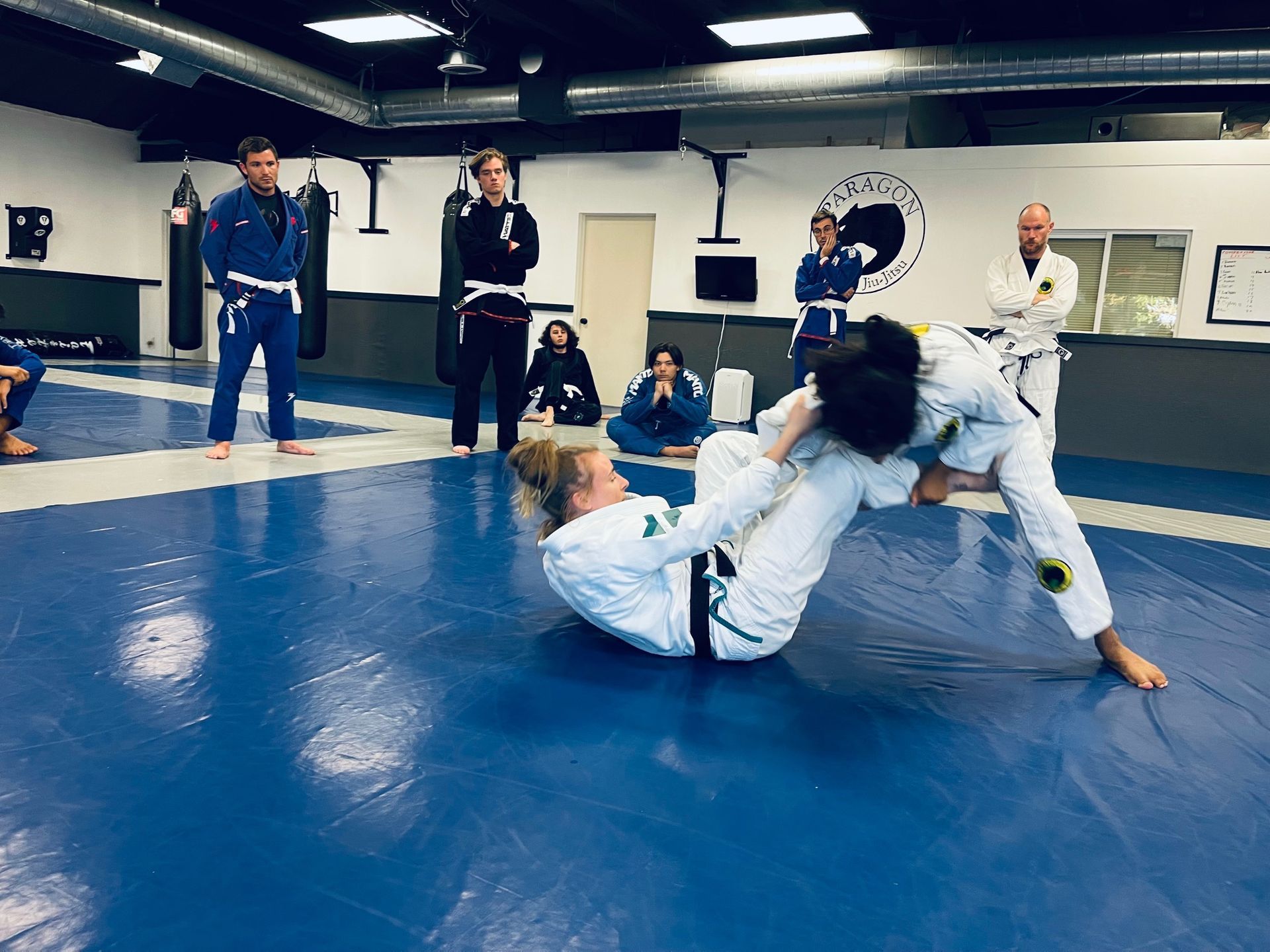
Every round in Brazilian Jiu-Jitsu gives you a problem to solve with real feedback. There is no hiding from the moment. If your base is off, you get swept. If your posture breaks, you get controlled. This might sound intense, but it is also what makes the training so effective for mental fortitude.
We structure classes so you learn, drill, and then apply techniques with appropriate intensity. That matters because resilience is not just about surviving hard moments. It is about staying present enough to learn from them.
Over time, you build a stronger relationship with discomfort. You realize you can be tired and still think. You can be frustrated and still make a good decision. You can lose a position and still recover. That is a powerful life skill, especially for adults balancing work, family, and a busy schedule.
Why our community approach changes the experience
In a place like Simi Valley, community matters. Life can feel spread out, people drive everywhere, schedules get packed, and it is easy to feel disconnected without meaning to. A solid training room becomes a social anchor. You see familiar faces, you learn each other’s names, and you get the simple benefit of showing up somewhere you are expected and supported.
We keep a culture where learning comes first. You will train with people at different levels, and you will get help along the way. Beginners are not treated like obstacles. Advanced students are not treated like celebrities. Everyone is responsible for creating a safe, respectful room.
That community piece is not separate from resilience, it is part of it. When you have training partners who want you to improve, you stay consistent. And consistency is where most transformation actually happens.
Gi and No-Gi: different tools for the same goal
Beginners often ask about the difference between Gi and No-Gi. In the Gi, you wear the traditional uniform and learn how grips, collars, and sleeves affect control. In No-Gi, you train without the uniform, which changes the pace and emphasizes body positioning, underhooks, and control without fabric grips.
We include both because each format teaches resilience differently. The Gi can feel like chess with grips, slow pressure, and detailed control. No-Gi can feel faster and more slippery, forcing you to adapt quickly and stay sharp in transitions. Both are valuable, and both build problem-solving under pressure.
No-Gi also has a practical appeal for many adults because it relates closely to everyday clothing. You learn how to control and escape without relying on a sleeve or collar. It is still sport training, but the carryover is easy to appreciate.
What you can expect in your first Brazilian Jiu-Jitsu class
Your first class should feel challenging, but not confusing in a bad way. We aim for clarity: what you are learning, why it works, and how to practice it safely. Most people are surprised by how technical it is, and also by how welcoming it feels once they step onto the mats.
Here is what a typical first experience includes:
• A quick orientation so you know where to stand, how to move safely, and how to communicate with training partners
• Fundamental movements like shrimping, bridging, and standing up with balance, because resilience starts with reliable mechanics
• A simple position or escape that gives you an immediate “this actually works” moment without needing strength
• Controlled partner drilling to build confidence through repetition, not chaos
• A chance to ask questions and look at the class schedule so you can plan a realistic routine
You do not need to be in shape to start. Training is what gets you in shape. You do not need to be flexible either, although you might get more flexible over time. What you need is willingness to learn and show up consistently.
Everyday resilience: how BJJ shows up off the mat
The most useful changes are often subtle. People tell us they handle stress better at work. They feel more patient at home. They sleep more deeply. They notice their posture and breathing during tense conversations. It is not magic, it is repetition. Brazilian Jiu-Jitsu trains you to return to baseline after pressure, and that is basically the definition of resilience.
You also learn to separate effort from emotion. When something is hard, you do not automatically assume it is a threat. You treat it as information. That shift can change the way you approach conflict, deadlines, and even your own self-talk.
And yes, there is the obvious benefit: you gain real self-defense capability. But the bigger win for many adults is the internal confidence that comes from knowing you can stay composed when things get uncomfortable.
A practical resilience checklist you can use this week
We like giving you something you can apply immediately, even before you feel “good” at grappling:
1. When stress spikes, exhale first, then decide what the next smallest useful action is
2. If you feel stuck, change one variable: angle, posture, grip, or pace
3. Treat mistakes like data, not identity, then repeat the rep with one adjustment
4. Build consistency with the class schedule, not with motivation, because motivation is unreliable
5. Track progress in months, not days, because resilience is built through accumulation
This is basically the same mindset you will practice in training: breathe, frame, escape, reset, improve.
Adult training goals: confidence, fitness, and stress relief
Adult students usually come in with a mix of goals. Some want effective self-defense. Some want a training routine that is more engaging than a treadmill. Some want a mental reset after work. We design our program so you can pursue any of those goals without needing to pick just one.
Brazilian Jiu-Jitsu is also scalable. You can train intensely if you want to compete, or you can keep it steady and technical if your priority is longevity. Either way, you build strength, mobility, and conditioning, but you also build focus. That focus is part of resilience, too.
And if your schedule or interests pull you toward striking, we also offer Adult Muay Thai Simi Valley, CA options that pair well with grappling. Many students enjoy mixing Brazilian Jiu-Jitsu with Adult Muay Thai in Simi Valley because it rounds out fitness, coordination, and stress relief in a way that stays interesting.
Take the Next Step
Building resilience is not about proving something. It is about giving yourself a reliable practice that makes daily life feel more manageable and more capable. Brazilian Jiu-Jitsu offers that because it trains calm decision-making under pressure, and it does it in a supportive environment where you can grow at your own pace.
If you want a place in Simi Valley where technique is emphasized, community is real, and training stays practical, we would love to show you what we do at Paragon Simi Valley. Our 5.0-star rating from 32 reviews reflects what we work for every day: a high-quality experience where beginners and experienced students can develop real, everyday resilience through authentic training.
Continue your martial arts journey beyond this article by joining a class at Paragon Simi Valley.