
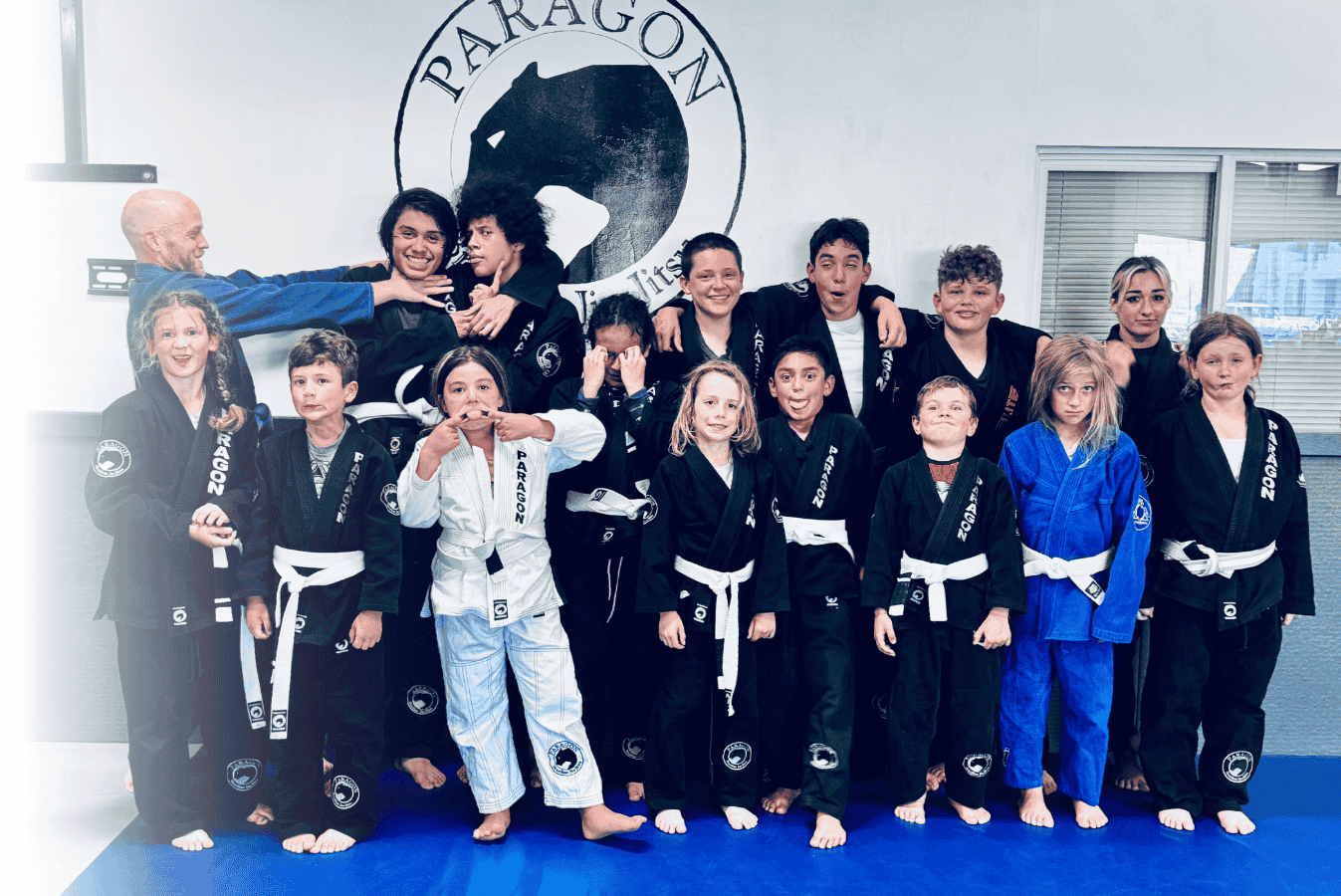
Youth Brazilian Jiu-Jitsu can give kids a calm, practical way to respond to grabs, pins, and pressure without turning training into fighting.
Parents in Simi Valley often ask us a simple question: can Youth Brazilian Jiu-Jitsu actually help a child protect themselves? Our answer is yes, with the kind of responsible framing that matters for kids. Real self-defense for children is not about winning a fight. It is about staying safe, creating space, getting away, and getting to an adult.
That is where Youth Brazilian Jiu-Jitsu stands out. Because it is built around control, balance, and leverage, it connects naturally to the kinds of situations kids realistically face: getting grabbed, shoved, tackled in rough play, or pinned during a bullying incident. At the same time, we keep expectations realistic. No martial art guarantees safety, and a good youth program should always reinforce prevention, communication, and adult support.
In our youth program, we treat self-defense as a sequence, not a single move. We want your child to notice risk early, set boundaries, and choose the safest option, even when that means disengaging instead of engaging. When physical skills are needed, we focus on age-appropriate escapes, posture, and control rather than striking or aggression.
What self-defense means for kids: notice, avoid, escape, report
When adults picture self-defense, it is easy to jump straight to techniques. For kids, we start earlier in the timeline. The best outcome is that your child does not end up in a physical situation at all. Youth Brazilian Jiu-Jitsu supports that mindset when it is taught with clear boundaries.
We teach kids that smart choices count as self-defense. That includes speaking up early, moving toward safer spaces, and getting help. If a child is ever grabbed or knocked down, then and only then do physical skills become relevant.
A practical kid-focused self-defense sequence looks like this:
1. Recognize the situation early and trust the uneasy feeling instead of ignoring it
2. Use a clear voice and strong boundary words like Stop, Back up, Leave me alone
3. Move toward safety, such as friends, staff, parents, or a more public area
4. Escape grips, create space, and stand up safely if contact happens
5. Report what happened to a trusted adult, even if it feels awkward
This is the framework we want families to share with kids at home, too. Training works best when your child hears the same message from coaches and parents: our goal is safety, not escalation.
Why Youth Brazilian Jiu-Jitsu fits common real-life kid scenarios
A lot of childhood conflict involves grabbing and wrestling, not clean punches. Someone pulls a backpack, pushes a shoulder, wraps an arm around a waist, or tries to hold a child down. BJJ is designed for those messy, close-range positions.
Because Youth Brazilian Jiu-Jitsu emphasizes grappling and positional control, kids build body awareness in a way that can translate to self-protection. In class, we practice how to base out so it is harder to knock you over, how to keep balance when someone is pushing, and how to move your hips and shoulders to make space. Those are not flashy skills, but they are the ones kids can actually remember under stress.
We also like that BJJ rewards calm problem-solving. A child who is smaller or less naturally athletic can still learn to improve position and escape using leverage. That does not mean size and strength never matter, because real situations are unpredictable, but it does mean your child is not limited to a strength-only approach.
The most useful skills: composure, escapes, and leverage
When parents ask what kids learn first in Youth Brazilian Jiu-Jitsu, the answer is usually not submissions. The foundation is movement and survival. That starts with understanding positions and how to stay safe inside them.
Staying calm under pressure
One of the hidden benefits of BJJ is that it teaches kids to feel pressure and still think. That might sound abstract until you watch a child learn to breathe while someone is holding them in a controlled drill. The first few classes can be a little intense for nervous beginners, and that is normal. With good coaching and progressive contact, kids usually stop panicking and start problem-solving.
Calm matters in self-defense because panic creates mistakes. A child who freezes cannot escape even a simple hold. In a good youth class, we create small, supervised challenges so kids practice staying composed.
Escaping pins and holds
In self-defense terms, escaping is often more important than controlling. Many real conflicts end quickly if a child can break a grip, get to their feet, and move away. We spend a lot of time on the idea that the ground is not where you want to stay.
We teach kids to protect their head, frame with their arms to create distance, and use hips and legs to recover position. Even something as basic as learning how to shrimp and bridge can help a child understand how to move out from underneath pressure.
Using leverage instead of force
Youth Brazilian Jiu-Jitsu rewards technique over brute strength. In practice, that means your child learns to align their body, use angles, and move their opponent’s balance rather than trying to overpower. That can be a confidence boost for smaller kids, and it can also help stronger kids learn restraint, which parents appreciate.
Technique does not eliminate risk, but it does reduce the urge to respond with wild movement. We would rather see a child create space and stand up cleanly than flail and escalate a situation.
Control, not aggression: BJJ without the wrong message
Parents sometimes worry that training will make a child more likely to fight. We take that concern seriously. Any martial art can be taught with the wrong tone, and kids copy what adults celebrate.
In our classes, we emphasize that physical skills come with responsibility. We reinforce tapping, stopping immediately, and listening. We also talk about when not to use technique. If your child can walk away safely, that is the win.
We also avoid teaching kids to chase domination. In a youth setting, self-defense is mostly about getting un-stuck. If a child is grabbed, our priority is escape and separation, not proving something.
Bullying: what training can help with, and what it cannot
Bullying is complicated. It can be social, verbal, or online, and it often continues even when a child becomes more confident physically. We never want to oversell martial arts as a one-step solution.
What Youth Brazilian Jiu-Jitsu can do is give your child a steadier posture, better awareness of personal space, and more confidence in their body. Many families notice that kids carry themselves differently after a few months. That shift alone may reduce how often certain kids get targeted, but we treat that as a possible benefit, not a promise.
What BJJ cannot replace is adult involvement. If bullying is happening, kids still need to tell you, tell a teacher or administrator, and document patterns. Training can support your child emotionally, but it should not become a reason to handle bullying alone.
Safety culture matters: what we prioritize in a youth program
Parents are right to evaluate safety before anything else. Grappling is physical, and while BJJ is often considered a non-striking martial art, injuries can still happen from falls, takedowns, awkward landings, or accidental contact.
We manage risk through structure and coaching. We keep the room organized, explain rules clearly, and step in early when movement gets sloppy. We also match partners thoughtfully by age, size, and experience, because that single decision changes the safety level immediately.
Here is a practical safety checklist you can use when you watch a class:
• Clean, well-maintained mats and clear hygiene expectations
• Qualified coaches who actively supervise instead of watching from a distance
• Partner matching that respects size, maturity, and skill level
• Progressive drilling that builds toward live practice rather than rushing it
• A clear tapping culture where kids stop immediately and reset
• A plan for injuries and suspected concussion symptoms like headache, dizziness, or nausea
Concussion awareness still matters in grappling. Even without strikes, a hard fall can cause symptoms. Any child who seems off after contact should stop training and be evaluated medically before returning.
Sparring and live rolling: when it helps and when to wait
Parents often ask when kids start sparring. Our approach is that intensity should match readiness. Younger kids usually begin with games, controlled drills, and positional practice that teaches safe movement without chaotic scrambles.
Live rolling can be a valuable learning tool when introduced at the right time. It helps kids apply techniques under pressure and learn real timing. But rushing it does not build toughness, it builds bad habits. We would rather see your child progress steadily than get thrown into hard rounds before their body control and emotional regulation are ready.
If your child is shy or anxious, we also treat that as normal. We can scale contact, coach through nerves, and help kids build comfort with safe, supervised physical interaction. For many beginners, the first breakthrough is simply realizing, I can breathe here, even when I feel stuck.
What a beginner experience usually looks like in our youth classes
A first class should feel organized and approachable, not intimidating. We keep instructions clear and repeat key points often, because kids learn through repetition. A typical class flow includes warmups that build coordination, technique practice with a partner, and a focused drill that reinforces one idea.
We also build habits that matter for self-defense and for life: paying attention, listening the first time, and staying respectful when emotions spike. Pediatric guidance often links martial arts participation with improved fitness, motor skills, concentration, discipline, and confidence, and our goal is to create the conditions where those benefits are more likely to show up over time.
As kids progress, training becomes more layered. They learn to connect techniques, not just memorize steps. They also learn that the safest option is often to disengage, stand up, and move away.
How often should your child train to build real skill?
Consistency beats intensity for most families. One class here and there can be fun, but steady practice is what builds calm reactions under pressure. For many kids, two classes per week is enough to start building skill without burning out.
We also want training to fit real life in Simi Valley. School workload, sleep, other sports, and family routines matter. A sustainable schedule makes it more likely your child will stay with it long enough to gain the benefits of Youth Brazilian Jiu-Jitsu, including the confidence that comes from seeing progress month after month.
If you are unsure, start lighter and build. Kids who feel successful tend to keep showing up, and showing up is where the growth happens.
Take the Next Step
If you want a realistic answer to whether Youth Brazilian Jiu-Jitsu can boost your child’s self-defense skills, the best approach is to see what a controlled, age-appropriate class looks like in person. At Paragon Simi Valley, we focus on composure, escapes, leverage, and respectful training habits so kids learn practical skills without being pushed toward aggression.
If you are exploring Youth Brazilian Jiu-Jitsu in Simi Valley because you want your child to feel safer, more confident, and more capable under pressure, we are ready to help you evaluate fit, readiness, and the right pace for progress.
Build your skills on the mats with consistent Jiu-Jitsu training at Paragon Simi Valley.